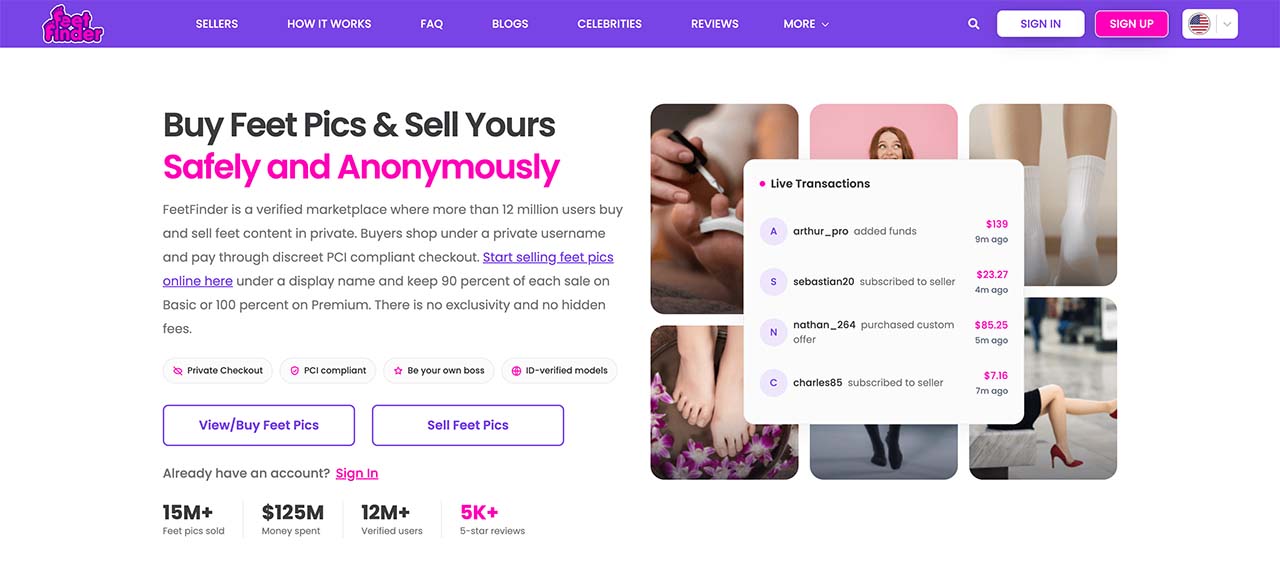
FeetFinder is worth considering if you want a dedicated place to sell feet photos and are willing to handle the messages, pricing, and repeat business that come with it. I would start with a small Basic plan trial. Paying for Premium before you know whether anyone wants your content is a harder choice to justify.
The appeal is a marketplace built around a specific interest, with listings and payments in one place. The drawbacks are less exciting: you pay to sell, sales can be zero, and earnings may take time to become withdrawable. Its public fee information also needs attention because different official pages currently show different commission rates.
What FeetFinder actually offers
FeetFinder is an adults-only marketplace for buying and selling feet content. Sellers can offer individual photos, albums, videos, subscriptions, and custom orders. A public display name and face-free content are allowed, while private seller identity and age checks still apply.
For a creator, that gives you several ways to package the same general interest. A ready-made album can be sold more than once. A custom order involves new work for one buyer. A subscription creates an ongoing expectation of fresh content. Those choices have very different demands on your time.
My preference for a beginner would be a small collection of clearly described albums, followed by a limited custom menu. That makes it easier to learn what people will actually pay for without promising a posting schedule you may struggle to maintain.
The niche focus is a useful advantage. A visitor already understands why the content is there. Still, being listed alongside relevant sellers does not tell you how many buyers will notice your page or choose your work.
FeetFinder pricing: separate the plan from the commission
FeetFinder’s public earnings guide lists the following seller-plan prices in US dollars. These are the advertised billing options, rather than prices observed inside a paid account.
| Billing option | Basic | Premium |
|---|---|---|
| Monthly | $4.99 per month | $14.99 per month |
| Annual | $14.99 per year | $49.99 per year |
| Lifetime | $40 one-time payment | $80 one-time payment |
The plan charge buys seller access. A separate commission reduces eligible sales. Registration being free does not mean listing content is free.
The commission information does not fully agree
When checked on October 24, 2026, the Terms of Service listed a 10% commission for Basic and 0% for Premium, with the seller-plan charge separate. The homepage and seller page used the same rates. However, the official earnings guide still calculated sales using 15% for Basic and 10% for Premium.
That is a meaningful difference. I would use the current contract rates for comparison, but save the fee disclosure shown during signup and ask support to resolve any mismatch before paying. A seller should be able to work out the cost without reconciling conflicting pages.
When does Premium make financial sense?
The examples below use the 10% Basic and 0% Premium commissions in the current terms, together with monthly plan billing. They exclude refunds, payout charges, production costs, and taxes. They illustrate costs, not expected earnings.
| Eligible monthly sales | Basic after commission and $4.99 plan | Premium after commission and $14.99 plan |
|---|---|---|
| $0 | -$4.99 | -$14.99 |
| $50 | $40.01 | $35.01 |
| $100 | $85.01 | $85.01 |
| $300 | $265.01 | $285.01 |
Under those assumptions, monthly Premium catches up at $100 in monthly sales. With the guide’s conflicting 15% and 10% rates, that point would be $200 instead. The commission that applies to your account therefore changes the plan decision.
Annual billing changes the calculation again. Using the contract rates, Premium costs $35 more per year and saves ten percentage points on sales, so the fee-only break-even is $350 in annual eligible sales. This comparison assumes both annual plans remain available at the listed prices.
Basic annual costs the same as three Basic monthly payments. That is worth considering if you already intend to give selling several months. For someone unsure about the work or privacy implications, paying $4.99 to try one month still limits the initial commitment. I would leave lifetime access until after completing a withdrawal and deciding the platform suits me.
Making sales involves more than uploading photos
The part of this business I would evaluate most carefully is customer interaction. Taking the pictures may be the easiest task to schedule. Answering questions, explaining an offer, discussing custom work, and deciding when to end an unproductive conversation can consume much more time.
A useful starting offer needs a clear theme and an accurate description. For example, an album built around a particular shoe style gives a buyer a more specific reason to purchase than a page full of unrelated images. That is a merchandising choice, not a promise that any particular theme will sell.
Albums also make the purchase easier to understand. Say what is included and price the complete set. For custom work, agree on the content, format, delivery time, and price before creating it. Avoid letting a low-priced order expand through repeated unpaid requests.
I would also resist cutting prices after every quiet day. A low price cannot solve an unclear offer or a lack of interested visitors. Change one part of the listing at a time so you can learn whether the preview, description, or price made a difference.
Repeat buyers would matter more to my decision than a busy inbox. A conversation is only useful commercially if it leads to a worthwhile order without pushing past your boundaries. If you dislike this kind of customer contact, FeetFinder may feel like far more work than the photos suggest.
Payouts: an account balance is not money in the bank
The seller page states a $30 minimum available balance for requesting a withdrawal. The terms specify a 30-day earnings review period, allow deductions for successful refunds or chargebacks, and permit additional verification before payouts. Withdrawal methods can vary by account and region.
That makes FeetFinder a poor choice for an urgent bill. Even a completed sale can leave you waiting for review, the minimum balance, and payment processing. I would confirm a usable withdrawal method before investing time in a large content library.
There is also a practical difference between covering a plan charge and reaching the withdrawal threshold. A few small sales might cover your subscription on paper while leaving too little available to cash out.
For a first withdrawal, keep the request confirmation and transaction details. If it stalls, ask support to identify whether the delay concerns the earnings review, account verification, or the payment provider. A specific status is more useful than a general assurance that payments are being processed.
Privacy helps, but has limits
The option to keep your face out of public listings is valuable. It lets you decide how much of your appearance belongs in the content. It does not mean the platform or payment providers can operate without your identity information.
Nor should a hidden face be treated as protection against every kind of recognition. A tattoo, reflection, familiar room, or reused username can connect content to your everyday identity. I would use a separate creator email and inspect each image before posting.
FeetFinder describes blurred previews and watermarking, while acknowledging that purchased content can still be copied. Those tools are useful friction rather than a guarantee of control after a sale.
Verification also has a narrow purpose. It cannot tell you whether a buyer will respect your time, behave honestly, or accept a refusal. Keep payment and order records within the platform, and do not send someone money because they claim it will unlock a larger payment.
What I like—and what makes me hesitate
- A clear niche: the marketplace gives feet-focused content an obvious home and buyers a direct way to browse it.
- Flexible offers: albums, custom orders, and subscriptions let a seller choose how much ongoing work to accept.
- A small initial trial cost: the listed Basic monthly price makes it possible to evaluate the work before a larger commitment.
- Inconsistent fee pages: conflicting official commission figures make a straightforward cost decision harder than necessary.
- Cash-flow restrictions: review periods and withdrawal conditions reduce the value of a sale when you need money quickly.
- Unpaid effort: creating content and handling messages can produce little or no return.
Who should try FeetFinder?
I would consider it for an adult who is comfortable with the content category, willing to complete private verification, and interested in learning how to sell a defined offer. A sensible trial budget must include time as well as the plan fee.
I would skip it if the attraction is effortless income, immediate cash, or complete anonymity. I would also hesitate if buyer conversations already sound exhausting. Those concerns affect whether the work fits your life even when the platform functions properly.
Before starting, set a spending limit and a date to review results. Track completed purchases, repeat customers, refunds, hours worked, and money actually withdrawn. If the numbers remain weak, continuing to pay needs a concrete reason beyond hoping the next month will be different.
Final verdict: worth a limited trial for the right seller
FeetFinder has a useful proposition: a focused place to list content, discuss orders, and receive payments. My recommendation is a cautious Basic trial, with the applicable commission and payout route confirmed first. Premium becomes easier to justify once actual sales support its extra cost.
The deciding factor is whether the full job suits you. If you enjoy building a small catalog and serving repeat buyers, FeetFinder could be a workable sales channel. If you only want to upload a few pictures and wait for income, I would keep the money and time for something that better matches your expectations.